CASE STUDY
Structuring Learning Around Clinical Reasoning
Sequencing content and learning activities to promote interpretation, application, and clinical decision-making.
ROLE
- Clinical Education
- Learning Design
CONTEXT
Digital learning platform for undergraduate medical education
ORGANIZATION
ScholarRx
Problem
Experienced clinicians think differently from novice learners. After years of practice, much of their reasoning becomes automatic. They instinctively recognize patterns, generate multiple diagnostic hypotheses, and identify the information that most effectively distinguishes between them. As a result, when they develop educational content, they often create comprehensive resources that explain the underlying science well, but leave much of the clinical reasoning implicit.
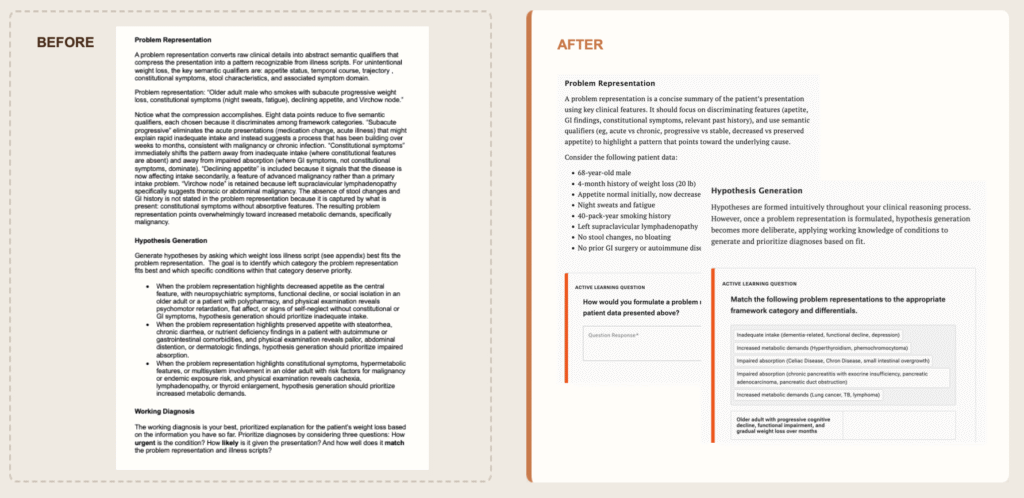
Developing a curriculum collection to teach students how to approach common clinical presentations highlighted this challenge. The content was clinically accurate and comprehensive, but it focused more on explaining clinical concepts than helping learners develop the reasoning process itself. Diagnostic thinking was often condensed into a single sentence, explanatory text became dense and repetitive, and opportunities to apply concepts were limited.
Approach
Rather than adding more content, I redesigned how learners encountered it. My work focused on making expert thinking explicit while reducing unnecessary cognitive load and creating more opportunities for learners to actively practice clinical reasoning.
Structure the learning journey around clinical reasoning
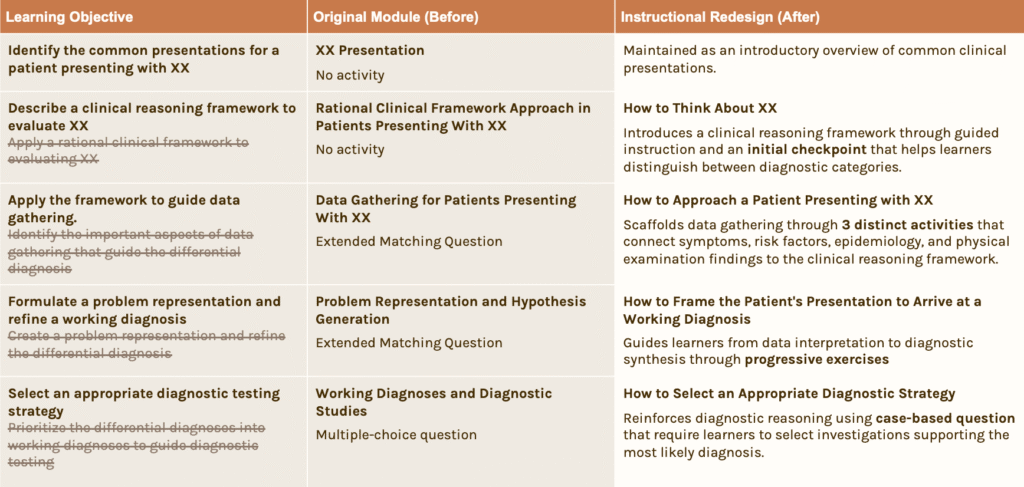
The original modules lacked a clear progression in both learning objectives and activities. I revised the objectives to progress from lower- to higher-order cognitive skills and aligned the content and application exercises with each objective, creating a coherent, scaffolded clinical reasoning experience.
Shift from explanation to interpretation and application
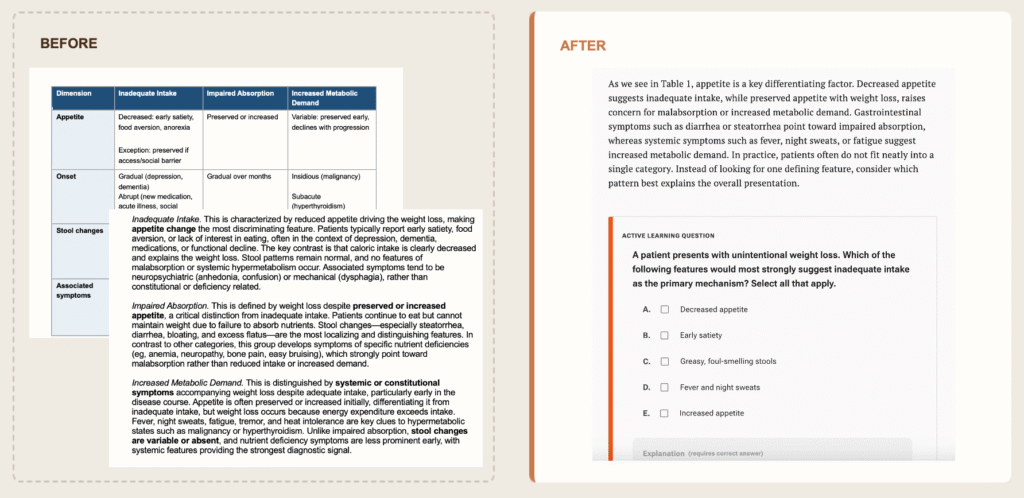
Long explanatory passages often repeated information that learners could already infer from tables and diagrams or recall from prior knowledge. Rather than increasing understanding, this added unnecessary cognitive load while limiting opportunities for active learning. I replaced much of this repetition with interpretation and application exercises that required learners to use the information before reading the explanation.
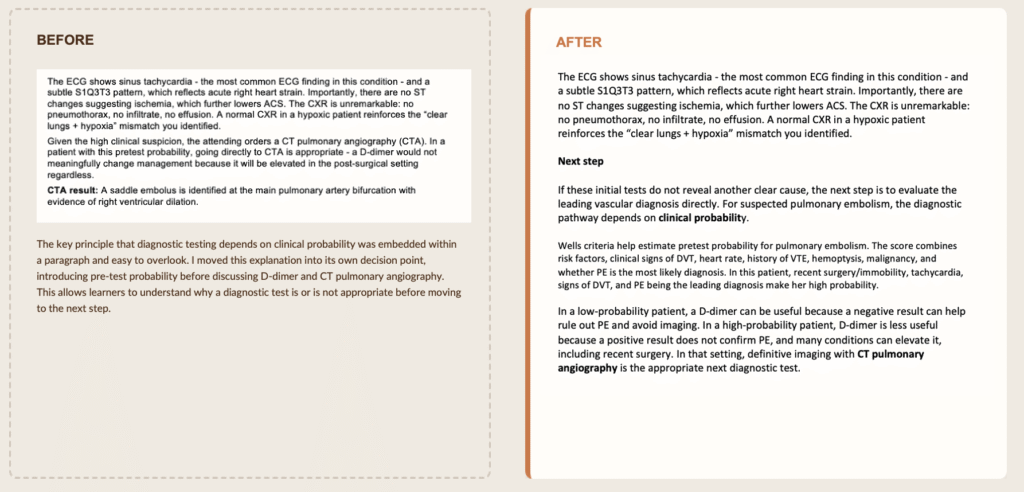
Introduce key concepts at relevant decision points
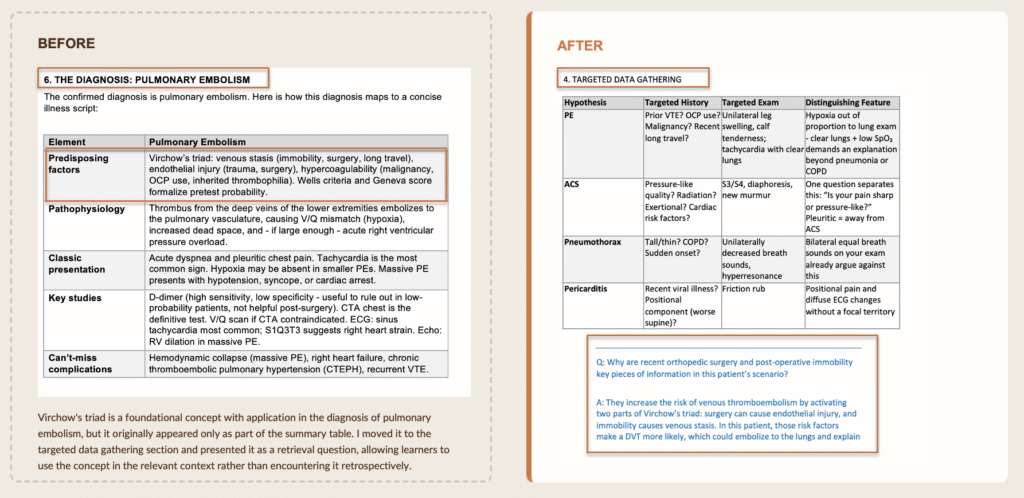
Learners are more likely to understand and retain concepts when they encounter them at the moment they become clinically meaningful. I repositioned key principles and diagnostic tools so they informed clinical decisions as they unfolded, allowing learners to apply foundational knowledge while building diagnostic hypotheses rather than encountering it later as isolated supporting information.
Signpost key learning messages
Medical experts often weave broader clinical insights into explanations of individual cases. I introduced dedicated Clinical Reasoning boxes to distinguish these transferable principles from case-specific content, helping learners recognize strategies they could apply across future clinical encounters.
Evidence
Example 1 – Learning Architecture
Curriculum collection on approaching common clinical presentations, illustrating how learning objectives, sequencing, and application activities were redesigned to scaffold clinical reasoning.
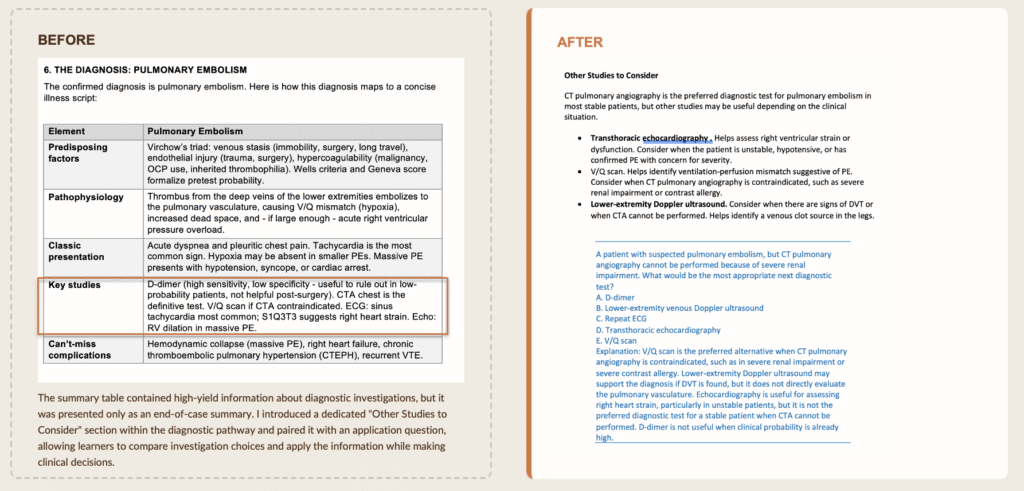
Example 2 – Information Architecture
Module on how to diagnose pulmonary embolism, Illustrating how key concepts were repositioned to support clinical decision-making at the point learners needed them.
What I learned
Bridging the gap between experts and learners
Working on this project reinforced something that first drew me to medical education. Clinicians bring invaluable expertise and real-world insight, but developing effective learning experiences requires looking at that expertise through the learner’s eyes. I found myself continually asking what learners needed at this stage, what reasoning remained implicit, and how the learning experience could better support their progression from novice to clinician.
The most meaningful changes weren’t adding new content, but redesigning how learners engaged with it. By structuring learning around the clinical reasoning process and creating opportunities to interpret, apply, and test ideas, the learning experience became less about explaining medicine and more about helping learners think through it.
Explore more
Discover related projects across learning design, curriculum development, and product strategy.